

We ARE.REGULAR has grown remarkably quickly grown into a stratospheric success. What was the original problem you set out to solve, and why did you feel existing products weren't doing it well enough?
Joely: The problem was simple: chronic constipation and bloating are incredibly common, genuinely debilitating, and almost entirely ignored by the wellness industry. Holly, my co-founder of WE ARE. REGULAR., spent 17 years dealing with chronic constipation. Seventeen years of trying everything on the market. Prescription laxatives, magnesium tablets, probiotic drinks, elimination diets. Nothing actually worked, and nothing was designed with any thought for the person taking it.
Holly: The clinical brands looked like they belonged in a hospital. The lifestyle brands were all vague claims and pretty packaging with little efficacy behind them. Joely and I looked at the category and saw a massive, unfilled gap: a brand that was honest about the problem, formulated to actually solve it, and didn't make you feel like a patient for having it. That was the brief. That became WE ARE. REGULAR.
Talking about digestive health and bowel habits still makes some people squirm. Did you ever worry that it would be a harder sell than a more glamorous wellness category?
Joely: Honestly? No. Because dismantling shame IS the opportunity. And most importantly, it is an opportunity that we have made our mission to remove. Everyone poos. Half the population is struggling with it. And yet the entire industry had agreed, silently, to talk around it in whispers and euphemisms. We decided that saying the word poo loudly, confidently, and without apology was not a risk, it was the strategy. The brands that hedged, that said ‘digestive comfort’ and ‘tummy wellness,’ hadn't solved the problem. We said poo. We said constipation. And it resonated with people because it was the first time a brand had actually spoken to them like a grown-up about something they'd been quietly suffering with for years.
Can you tell us the story of how the two of you came together to create We Are Regular?
Holly: Joely and I have been in the beauty industry for over 20 years combined. Joely as Head of Beauty at Grazia, me as Commercial Director at Skin Rocks. We met when we were 16 in a Leeds nightclub and have been best friends ever since. We knew how to build brands, how to talk to women, how to cut through noise. And we both knew, from personal experience, that the gut health space was a mess. The eureka wasn't a single moment, it was more of a slow-burning realisation. We kept coming back to the same conversation: why is there nothing that works AND looks good AND talks to women humanistically? Why is everyone dancing around the word poo? The more we talked about it, the more obvious it became that we had to be the ones to do it.
Businesses that appear to be overnight successes usually involve a great deal of unseen graft. What did those early months really look like behind the scenes?
Holly: Chaotic, terrifying, and brilliant in equal measure. We spent 18 months building WE ARE. REGULAR. behind the scenes, whilst in full-time, intense careers that were demanding in their own way. Juggling both allowed us to naturally reach the point where we knew, enough was enough, and we had to go all in. Which we did individually on our own time, neither of us pressured the other to leave our jobs. We just trusted our gut. (pun intended).
Joely: We then launched in September 2025, hit six figures in five weeks and sold out in seven. Which sounds incredible and it was, until you realise that selling out meant we had no product to sell for a full month. That month was brutal. We'd built real momentum, we had customers ready to buy, and we had nothing to give them. It was an expensive lesson in supply chain management that we will never repeat. We even had customers begging to pay anything if we could provide them with relief. Behind every ‘we sold out!’ post is a founder absolutely panicking about when the next shipment arrives.

You've now delivered more than 170,000 poos. Was there a moment when you looked at the numbers and thought, ‘This might really be taking off’?
Joely: There were a few. The first was when we hit six figures in five weeks from a standing start, no retail, no big influencer campaigns, just the product and the story. The second was when the Daily Mail ran Holly's 17-year constipation story, and we did almost 1,000 orders in a single day. But honestly, the number that gets me every time is the returning customer rate. Over half of everyone who buys from us comes back. In e-commerce, that is not normal, especially not in such a short space of time. That tells you the product works. You don't return to something that doesn't.
“‘We pitched Boots before we even had a finished product to show them – a story we will shout about forever, because it is completely true and slightly mad.’
”
Tell us about the product itself – what's in it and how does it work?
Joely: Holly and I spent 17 years trying to fix this problem ourselves. I know exactly what it's like to stand in a pharmacy scanning the supplements aisle, trying yet another capsule or tablet that promises relief and delivers very little. Most gut health supplements don't contain enough formulation to make an impact on constipation, particularly when you suffer from slow transit. For many people fibre can make it worse, probiotics are the long-term game and when you're in the depths of constipation, you just want fast relief.
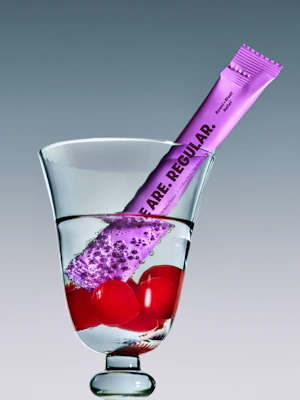
Holly: One sachet a day, 8.4g of good-for-your-gut ingredients, wild berry flavour that you mix with water. In terms of what you're getting, it's the equivalent of taking 14 capsules in a single dose. The formulation combines Magnesium Citrate, L-Glutamine, Vitamin C, Ginger Extract, Peppermint Leaf, Rosehip, Grapeseed, Amla Berry and Barley Grass. Magnesium Citrate is the workhorse: it draws water into the bowel, softening stools and stimulating movement. L-Glutamine supports the gut lining. The botanicals reduce bloating and inflammation. Everything is natural, nothing synthetic, no fillers. And I know it works because I take it every single day and I have not looked back since. I mean, we built a business on it. I believe in its efficacy.
Joely: Our trial results back it up: 79% of participants had a satisfying poo within 24 hours, and by day 7, 100% reported stools that were soft and easy to pass. That is what efficacy looks like.
Your return rate sits at just 0.1 per cent, which is extraordinary. Why do you think customers respond so positively once they've tried it?
Holly: Because it works. That's it, really. You cannot fake a 0.1% return rate. It's a direct reflection of what happens when someone tries the product for the first time and, often for the first time in years, feels genuine relief. We have a customer who spent almost 30 years taking pharmaceutical medication to relieve her gut issues of bloating and constipation. She now exclusively takes 01. Bowel + Bloat Relief. That's why we built this. When you've been constipated for that long, you don't send it back. You tell your friends about it. You subscribe. You DM us at 11pm on a Tuesday to say thank you. That's the REGULAR. experience, and it is entirely product-led.
“‘We've been sold a very simplified version of what good gut health looks like. Eat fibre, drink water, eat more kiwis. And when that doesn't fix it, people assume it's their fault. The reality is more complex.’
”
Gut health is one of the biggest conversations in wellness right now. Yet many people struggle with digestion even when they eat well and exercise regularly. Why do you think that is?
Joely: Because we've been sold a very simplified version of what good gut health looks like. Eat fibre, drink water, eat more kiwis. And when that doesn't fix it, people assume it's their fault. The reality is more complex. Stress is one of the biggest drivers of constipation and bloating. I, Holly, would exclusively poo at 6pm on a Friday evening: after a stressful week, my bowels finally said, I'm ready. And even then it would be an unadmirable poo. Rabbit droppings were my only style. Hormones play a massive role, particularly for women, and again, barely discussed. Travel, disrupted routines, changes in sleep: all of it hits the gut hard. Good diet is necessary but not sufficient. What's missing is a targeted, daily intervention that addresses the mechanics of the problem rather than just the lifestyle around it.
Many wellness brands focus heavily on building large social media audiences, yet you've grown largely through customer loyalty and word of mouth. Was that a deliberate strategy from the beginning?
Holly: Partly deliberate, partly what the product demanded. We were never going to out-post a brand with a team of twenty. What we could do was create something that worked so well that customers became advocates. Our conversion rate sits at 6%, which is unusually high for e-commerce and tells you something important: the people arriving at our site are arriving with intent. They've heard about us from someone they trust. Word of mouth is not a strategy you can manufacture, but you can earn it by doing the work properly, and then making sure every touchpoint, from the packaging to the customer service to the newsletter, reinforces why they made the right decision. We have more customers than we do Instagram followers, and honestly we're so proud of that, because in a world where everyone focuses entirely on social, it's a reminder that there is more to play for than just follows.
Subscriptions have grown from zero to almost a third of revenue within six months. Has customer behaviour surprised you in any way since launch?
Joely: Yes, the speed of it. Our target audience told us in research that they were resistant to subscriptions until a product proved itself. And we believed them. So we didn't push subscriptions hard in the early months. We even launched it ahead of schedule because our customers were begging for it, because the product delivered on its promise and they didn't want to risk running out. What that tells us is that relief, once found, is not something people are willing to give up. The subscription isn't a lock-in. It's a trust signal. And trust, it turns out, converts quickly.
Securing a national launch in Boots is a major milestone for any young brand. How did that partnership come about, and what has it meant for the business?
Joely: We pitched Boots before we even had a finished product to show them – a story we will shout about forever, because it is completely true and slightly mad. We walked into lunch with our brand, our formulation, our vision, and the conviction that this product belonged on that shelf. They agreed. The launch in May 2026 across 50 stores is the beginning of what we believe is a long-term retail relationship. Boots means access to women who aren't necessarily on social media, who find us in a pharmacy on a lunch break, who pick up the Travel Pack before a holiday. It validates the brand and broadens the audience simultaneously. And September 2026, when we move into the digestion category properly, is when it gets really interesting. We're so excited that Boots is our first retailer. They were, and have always been, our dream partner. The retailer we fantasised about when we first began building this brand.
The wellness market is more crowded than ever. What do you think consumers are looking for today that perhaps they weren't five years ago?
Holly: Efficacy and honesty, in that order. The era of ‘this superfood will change your life’ is over. People have been burned too many times by products that promised transformation and delivered nothing. The consumer today is more sceptical, more informed, and more demanding. They want to know what's in it, how it works, and what other real people have experienced. They want brands that treat them like adults. They don't want wellness marketed as aspiration, they want solutions and they want to move on with their day. That's why we built WE ARE. REGULAR. Because we believe that as women, we have incredibly busy, demanding lives. Living with something as debilitating as constipation does not need to be something that holds you back. We don't have time for that.
What has been the biggest challenge behind the scenes that customers wouldn't necessarily see?
Joely: Selling out in our first two months was the hardest thing we've faced so far. Selling out sounds like a success story, and it is, until it isn't. We lost a full month of revenue at a critical growth moment. Operationally, scaling a physical product business is genuinely hard. Manufacturing lead times, cash flow tied up in stock, managing growth without over-extending: none of it is glamorous and all of it requires constant attention. The brand you see is the tip of a lot of unglamorous logistics.
If you could change just one thing about the way people think about gut health, what would it be?
Holly: That it's optional. People treat regular, comfortable digestion as a bonus rather than a baseline. They accept years of bloating, constipation, discomfort, as just "how they are." It's not. Regularity is not a wellness luxury, it's fundamental. I lived 17 years not in crippling pain but with a gentle hum of uncomfortability, low mood, depleted energy that felt relentless. That kind of knowing can, at times, be more persistent and draining. We want every person who has spent years quietly suffering to know that there is a solution, that you deserve to find it, and that talking about it is not embarrassing. It's necessary.
You've built a business around helping people do something that is entirely natural, yet rarely discussed. What's the most surprising thing you've learned about people's relationship with their own bodies since launching the brand?
Holly: How much shame is wrapped up in it. We knew the poo taboo was real, but we didn't fully appreciate how deep it runs until we started hearing from customers directly. People who haven't spoken about their constipation to their closest friends, to their partners, sometimes not even to their doctors, reach out to tell us it's the first time they've talked about it openly.
Joely: Women thanking us for making them feel less alone about something their body does every day. That's not what we expected when we launched a supplement brand. But it's what drives us, because solving a physical problem and removing the shame around it at the same time, that's actually meaningful work. And it was our entire mission from the start.
What's next? Having achieved so much so quickly, where do you hope WE.ARE.REGULAR will be this time next year?
Holly: Past £1 million in annual sales, scaling physical retail, shipping internationally, and with Joely back from maternity leave. The September 2026 Boots move into the digestion category is the commercial milestone we're building toward right now. That's the shelf we've always belonged on - it’s where people go who have the problem, and are looking for targeted relief. Beyond the UK, we have our sights on Australia.
Joely: Longer term, WE ARE. REGULAR. is a multi-product brand but for now there’s millions of people who still need to know us for poo – so that’s very much our focus. We've proved the model works. We've proved the audience is there and the demand is real. Now it's about building the infrastructure to grow without losing what makes people fall in love with us in the first place: a product that actually works, and a brand with the courage to say the things many are afraid to say.